
Thinking ahead 💭
Consultant to Founder #12

Among the thousands of skills a first-time founder has to learn, there is one I’ve started putting real mental energy into lately - thinking ahead.
Thinking ahead means asking yourself: what do I have to do now to achieve XX in YY months.
It sounds obvious.
Trust me, it’s not.
Let me elaborate.

0 to 1
When you are going from 0 to 1, there is not much “thinking ahead”.
You are in full discovery mode. You want to understand the problem you are solving, and you want to fit the customer’s demand whatever it takes.
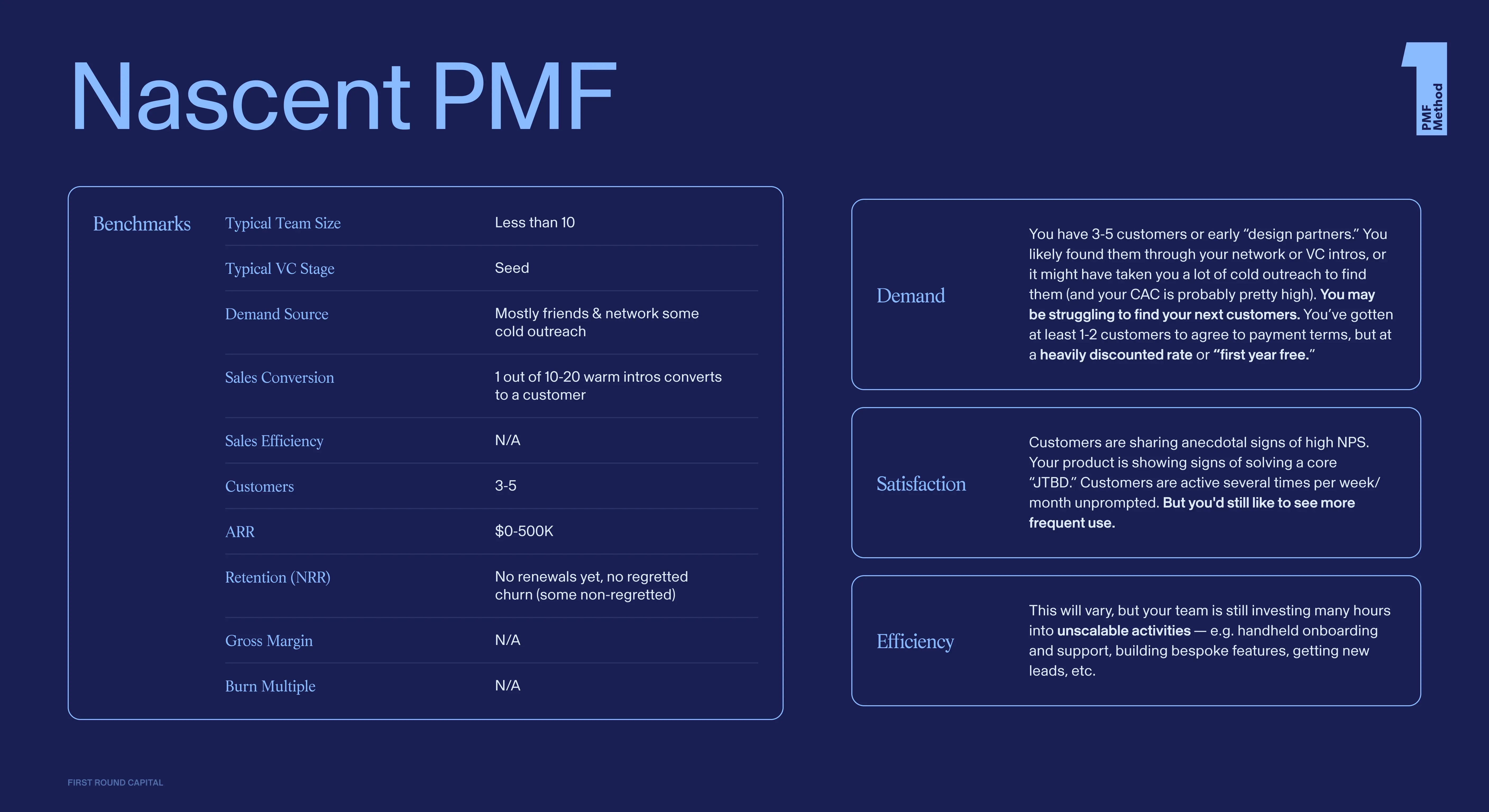
You work your ass off to prove there is a problem-market fit. For the more theoretical among us, as First Round explains in their PMF playbook, here you are at Level 1 of the PMF journey (see more here).
This means you try to sell, you learn by selling, and you build accordingly. You keep iterating until, at some point, it doesn’t scale.
By learning more, you get better. Your product improves, your storytelling becomes clearer, and you grow at an increasing pace. But you are capped.
What allowed you to win your first customers is not industrialized and not 100% repeatable. And that’s fine, because at this stage, that was not your focus, and correctly so.
The mindset shift: from 0 to 1, to 1 to 10
If you’re lucky, and good enough, to secure your first customers, make them genuinely happy, and start seeing patterns, the next question becomes unavoidable:
How the f**k do we make sure this is not random luck and magic, and that what we did so far can be repeated at an increasing pace?
Some concrete examples from our experience at Compri:
As a founder, I personally generated and closed most of our first customers. How do we make sure the sales team becomes fully autonomous and effective in doing the same in 12 months?
Assuming our growth targets, how do we restructure the onboarding team, processes, and technology so we can keep up with the sales pace expected in 12 months?
These are questions we always knew we would have to answer. We just postponed answering fully to them, because in the 0 to 1 phase there was always a more urgent fire to put out.
So we kept operating like insane execution machines, pouring hours into unlocking the next milestone, until the next milestone became unreachable with execution alone 🙂
Now we’ve reached a point where either we stop, reflect, plan ahead, and act, or pure execution will make us drown.
How to do it
We are still figuring this out, but there are some immediate steps we are taking and that I’ll share more about over time.
A) Reasoning “OKR-style”
For each specific goal we set, usually aligned with fundraising timelines, we define:
The levers that allow us to reach that goal
Which levers we bet on, and which ones we explicitly deprioritize
Periodic milestones toward the final objective
Which actions we take along the way
We monitor progress and re-adjust
A very basic sales example for 1 goal “I want to generate €XXM in ARR in 12 months”:
We can do it via inbound, outbound and client referrals
I decide to bet only on inbound and deprioritize the rest as I deem these 2 less relevant
Every quarter I expect to add €YYM ARR from inbound
To reach this in Q1 I’ll hire a Growth Lead, in Q2 I'll invest in paid ads, and in Q3 I’ll launch a PR push (ofc with targets linked to each action)
Every quarter I check whether I’m on track and, if not, I take corrective actions
Simple in theory, much harder in practice.
B) Finding people who act as founder multipliers
This connects to the idea that founders are capped, which we already discussed before (see below), but it becomes critical at this stage.

With so many initiatives in play, you need to make sure your time is unlocked and that someone else absorbs part of the complexity and execution. Otherwise, you inevitably become the bottleneck.
That’s why we’re seeing more Founder’s Associate or Chief of Staff roles already at Seed and Series A companies. Several top-tier VCs actively suggest this to their portfolio companies.
Another role that can dramatically lift founders is Head of People, especially once hiring, performance management, and culture start to matter more.
These are staff function, and they don’t come with an obvious or immediate ROI. If you’re an anxious ex-consultant like me, your instinct is often to postpone them.
But if you’re truly playing to win, you add them sooner rather than later to avoid becoming the limiting factor for your company’s growth.
C) Use your investors as a real sounding board
As you start tackling repeatability and scalability problems, patterns begin to emerge.
In the 0 to 1 phase, everything feels unique and hard to compare. As you move forward, best practices become more visible and transferable.
We’ve found it extremely valuable to use our investors as an always-on sounding board, with deep sessions focused on identifying bottlenecks toward our goals.
It’s uncomfortable when things get tough, but everyone knows how hard this journey is. Ask for help and get the most out of them.
If that means going through every single initiative in an Excel sheet, do it. There is no better way to show that you’ve thought things through and that you’re tackling the challenge in the most structured way possible.
“What got you here won’t get you there”
Thinking ahead is not about predicting the future or pretending you have everything under control. It’s about acknowledging that what got you here will not get you there, and acting accordingly before reality forces you to.
Execution will always matter. But at some point, the real leverage comes from stepping back, making deliberate bets, and designing the company you want to run in 12 months, not the one you’re barely surviving today.
This shift is uncomfortable, especially for workaholic founders that are execution machines (ref. consulting style). But it’s the mental shift needed to start building a real Company.